
SteelSeries Aerox 3 Wireless Review: A Featherweight FPS Weapon With Surprising Endurance
Introduction
The SteelSeries Aerox 3 Wireless is designed for players who crave speed without sacrificing control. With an ultralight shell, dual wireless connectivity, and a flagship-grade optical sensor, it aims squarely at competitive FPS and fast-paced esports. Add water-resistant protection, fast charging, and refined software, and you have a mouse that promises premium performance at a mid-tier price. In this review, we dig into strengths, weaknesses, and whether it’s the right fit for your setup.. For a For a proven esports-grade ultralight wireless alternative with an ambidextrous shape, compare it against the Razer Viper Ultimate., consider our Razer Viper Ultimate.
Key Features and Specifications
The Aerox 3 Wireless blends modern wireless tech, performance parts, and a purpose-built shape for agility. While exact figures vary slightly by revision, the fundamentals remain consistent. Here are the headline features that define the experience:. For a If you want similar lightweight wireless performance at a friendlier price, consider the NZXT Lift Wireless., consider our NZXT Lift Wireless.
- Ultralight weight: Approximately 66–68 g depending on edition, helping reduce fatigue during long sessions and enabling faster flicks and micro-adjustments.
- Wireless options: Quantum 2.0 2.4 GHz low-latency wireless for gaming and Bluetooth 5.0 for productivity or multi-device use.
- Sensor: SteelSeries TrueMove Air (custom PixArt), with up to 18,000 CPI, 400 IPS tracking speed, and 40G acceleration—engineered for 1:1 tracking and low jitter.
- Battery life: Up to a claimed 200 hours via Bluetooth; strong endurance on 2.4 GHz as well (actual life varies by polling rate and RGB usage). Fast charging can provide many hours of use from a short top-up.
- Switches: Golden Micro IP54 mechanical switches rated for up to 80 million actuations, offering crisp, reliable clicks while resisting dust and moisture.
- Water and dust resistance: AquaBarrier protection with an IP54 rating helps safeguard the PCB, switches, and sensor despite the perforated shell.
- Feet and glide: 100% PTFE (Virgin grade) skates for a smooth, low-friction glide on cloth and hard pads; rounded edges minimize scratchiness.
- Charging and cable: Detachable USB-C port at the front; flexible Super Mesh cable included for charging and wired play.
- Lighting: SteelSeries PrismSync RGB (three-zone), customizable in SteelSeries GG/Engine with effects that can be tuned for minimal power draw.
- Polling rate: Up to 1000 Hz on the 2.4 GHz dongle; standard 125 Hz on Bluetooth.
- Shape and size: Low-profile, symmetrical shell with left-side buttons; best for claw and fingertip grips, suitable for many medium-hand users.
- Software and profiles: SteelSeries GG/Engine supports CPI steps, polling rate, macros, key assignments, LOD tweaks, and onboard profile saving for core settings.
Together, these specifications position the Aerox 3 Wireless as a nimble, competition-ready mouse that doesn’t require a high-end budget.
Performance and Quality
On the pad, the Aerox 3 Wireless feels quick and controlled. The TrueMove Air sensor is a standout: it tracks consistently at low and high sensitivities and remains stable across common mousepads. There’s minimal smoothing within typical CPI ranges, and any micro-corrections feel predictable rather than jumpy. In fast-paced shooters—think Valorant, CS2, Apex Legends, or Overwatch—the mouse keeps up effortlessly with sudden flicks and fast tracking.
Wireless reliability is excellent in 2.4 GHz mode. Input latency is effectively imperceptible in normal play and holds up well in aim trainers. Polling at 1000 Hz is stable, with no random drops under typical conditions. Bluetooth is convenient for laptops and secondary devices, though it’s not recommended for competitive play due to its inherently higher latency; still, it’s perfectly fine for browsing, productivity, and indie titles where split-second precision isn’t required.
The clicks feel crisp and responsive. Golden Micro IP54 switches bring a distinct tactile snap without excessive preload. There is mild pre- or post-travel on some units, but nothing that detracts in actual use. The scroll wheel steps are defined and grippy, with a moderately light middle-click that doesn’t trigger accidentally yet remains easy to actuate for weapon swaps and utility binds.
Glide is strong out of the box thanks to 100% PTFE feet. They’re slightly thicker than many stock skates and have rounded edges, so they don’t dig into softer cloth pads. On hard surfaces, the glide is quick with a controlled stop. After a short break-in, friction becomes very consistent. If you prefer an even airier feel, third-party feet can marginally lower friction, but most users won’t find it necessary.
Battery life depends on how you configure RGB and polling. With lighting toned down or off and at 1000 Hz, multi-day sessions on 2.4 GHz are realistic for average usage. The quoted up to 200 hours refers primarily to Bluetooth at conservative settings; competitive settings will reduce that figure substantially, as expected. Fortunately, the fast-charge implementation means a quick plug-in—say 15 minutes—can give you enough charge to power through an evening session.
From a quality standpoint, the mouse inspires confidence. There’s no significant sensor rattle, wheel wobble is minimal, and side flex is well controlled for a perforated shell. The open-honeycomb design does mean you can hear a faint resonance if you tap the shell, but in play it’s a non-issue. Firmware stability is good, and SteelSeries GG/Engine updates have been reliable in our experience, with changes taking effect quickly and settings stored correctly.
Design and Build Quality
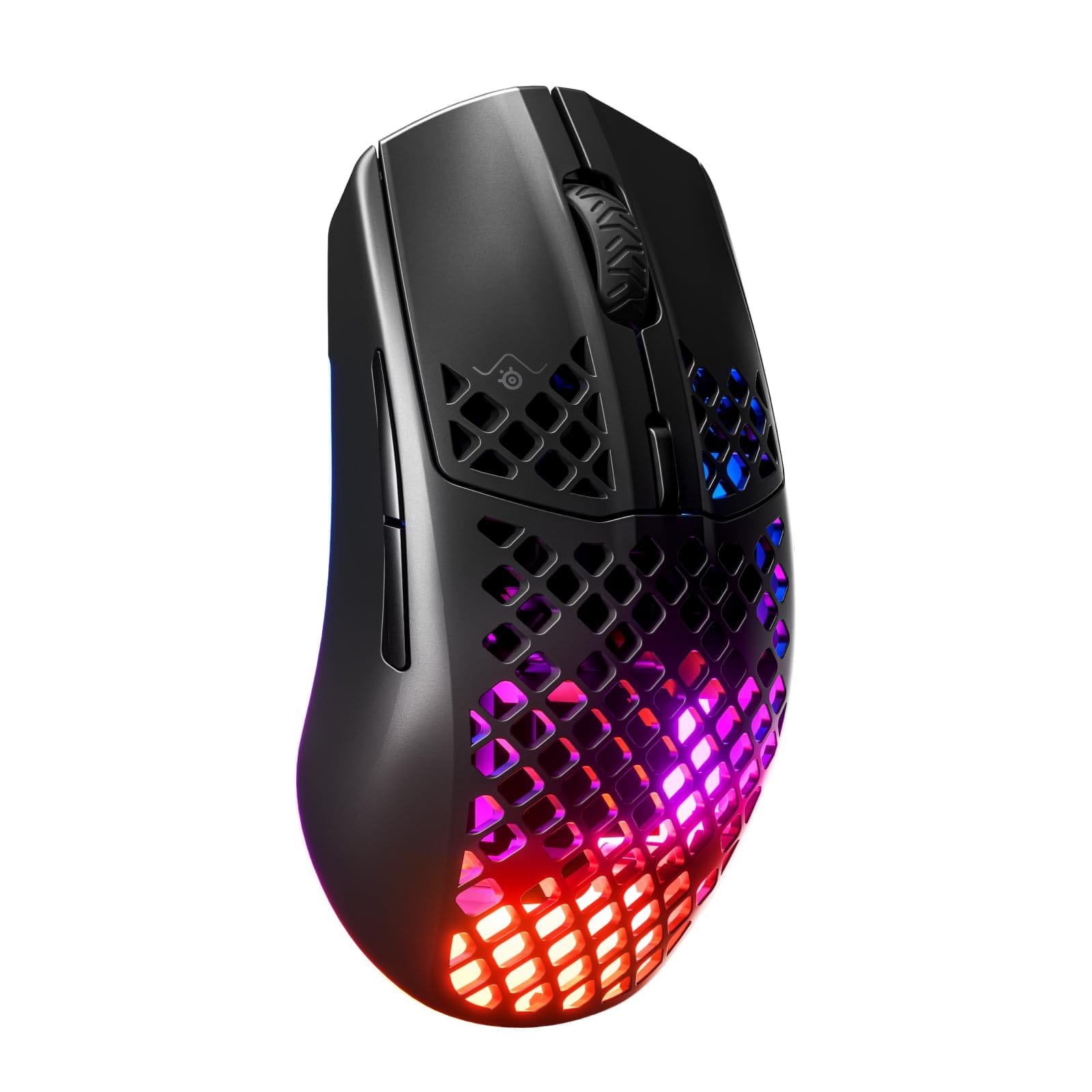
The Aerox 3 Wireless stands out with its perforated, ultralight shell and restrained design language. It’s a symmetrical shape with side buttons only on the left, so it’s functionally right-handed while maintaining an ambidextrous feel in-hand. The low-profile back and subtly flared rear corners provide strong claw control, and fingertip users will appreciate the minimal weight and balanced center of gravity.
Despite the holes, SteelSeries uses an AquaBarrier coating to achieve an IP54 rating against dust and splashes, protecting critical internals like the sensor and switch mechanisms. This helps offset one of the typical concerns with honeycomb mice: exposure to debris. It also contributes to longevity, particularly if you game in warm environments where sweat and humidity are common.
The surface coating is a finely textured matte finish that resists fingerprints and offers solid grip without being overly abrasive. The side panels have subtle texture and gentle curves for the thumb and ring finger to anchor comfortably. In long sessions, the airy shell does a good job of keeping palms cooler than solid-shelled mice—a noticeable comfort perk for marathon gaming or hot climates.
SteelSeries fits the Aerox 3 Wireless with USB-C up front, which is a big quality-of-life win. You can use the included Super Mesh cable while charging, and it’s soft enough that wired play doesn’t feel like a compromise. The dongle extension/charging cable also lets you position the 2.4 GHz receiver close to your pad to maximize signal quality.
In terms of durability, the mouse resists creaks and flexing better than many ultra-light competitors in its price tier. Pressing hard on the side panels produces only slight give. The primary button separation minimizes accidental click actuation when resting fingers on the shell. Over time, the PTFE feet wear evenly, and replacement sets are inexpensive if you want a fresh glide down the road.
Lighting is tasteful and diffused through the shell, with a three-zone RGB implementation. You can run static colors, breathing, or synchronize with other SteelSeries gear via PrismSync. If you care about battery life, reducing brightness or disabling lighting entirely yields a meaningful extension, and the mouse still looks clean without the glow.
Pros and Cons
Every gaming mouse makes trade-offs. Here’s what stands out on both sides of the ledger for the Aerox 3 Wireless:
- Pros
- Ultralight at around 66–68 g, yet feels solid for a perforated design.
- Dual wireless (2.4 GHz + Bluetooth) with stable 1000 Hz polling on the dongle.
- TrueMove Air sensor delivers accurate, consistent tracking for competitive play.
- IP54 AquaBarrier adds real-world durability against dust, sweat, and accidental splashes.
- USB-C charging and a flexible, usable cable for play-while-charging.
- Comfortable, low-profile shape favors claw and fingertip grips; excellent weight balance.
- 100% PTFE feet with smooth, fast glide out of the box.
- Reasonable price point with frequent discounts below many flagship ultralights.
- Cons
- Battery life claims (up to 200 hours) reflect Bluetooth and conservative settings; 2.4 GHz at 1000 Hz with RGB will be notably lower.
- Perforated shell lets dust and pet hair reach the interior more easily, even with protection.
- Side buttons are on the smaller side and can feel a bit shallow for users with larger thumbs.
- Max polling rate is 1000 Hz; no 4K/8K options for users chasing ultra-low latency metrics.
- Software suite (SteelSeries GG/Engine) is feature-rich but relatively heavy compared to lightweight config tools.
- Shape is less ideal for large hands that prefer a full palm grip or higher back arch.
Value Proposition, Pricing, and Alternatives
One of the Aerox 3 Wireless’s best qualities is how much it offers for the price. The MSRP commonly sits in the $99–$119 range depending on edition and region, but street prices often dip into the $69–$89 bracket during sales. For that, you get a genuinely light, esports-capable wireless mouse with a great sensor, dependable 2.4 GHz performance, and thoughtful features like IP54 protection and USB-C.
At its typical sale price, the Aerox 3 Wireless undercuts many flagship ultralights while delivering most of the on-pad performance those pricier models tout. When budget is a consideration, it represents a sweet spot between no-frills value mice and high-end pro staples. Its combination of low weight, reliable sensor, and comfortable shape is hard to beat in the sub-$100 segment.
That said, there are notable alternatives, each with its own appeal:
- Logitech G Pro X Superlight (and Superlight 2): At around 63 g (and even lighter on the SL2) with class-leading wireless and HERO sensor efficiency, Logitech’s pro line remains a top competitive choice. Downsides are price (often $149–$159+) and no Bluetooth. The Aerox 3 Wireless is more affordable and adds dual wireless plus IP54 protection, though it’s slightly heavier and capped at 1000 Hz.
- Razer Viper V2 Pro: Around 58 g with an excellent Focus Pro 30K sensor and exceptional battery life at 1000 Hz. Premium pricing and the absence of Bluetooth make it a purist’s tool. The Aerox 3 Wireless offers better value if you want dual-mode convenience and a lower entry cost.
- Glorious Model O Wireless / Model O 2 Wireless: Similar honeycomb ethos and competitive weight, often priced aggressively on sale. Software and QC have improved over time, but SteelSeries’s AquaBarrier and overall ecosystem polish give the Aerox 3 Wireless an edge in durability and setup experience.
- Razer Orochi V2: A compact, ultra-light battery-powered option with stellar endurance and dual wireless. Its smaller, travel-friendly shape won’t suit everyone, whereas the Aerox 3 Wireless offers a more standard mid-size shell and a rechargeable internal battery.
- Budget pick: Logitech G305 or SteelSeries Rival 3 Wireless: Heavier due to batteries but extremely affordable and reliable. If weight is your top priority, the Aerox 3 Wireless is the far better performer; if price is paramount, these are great entry points.
In short, the Aerox 3 Wireless competes well on performance and wins decisively on price when discounted. If you’re seeking the last 1–2% of latency and endurance, premium flagships might edge it out; for most players, especially those upgrading from heavier legacy mice, the Aerox 3 Wireless will feel transformative without the flagship price tag.
Who Should Buy the SteelSeries Aerox 3 Wireless
This mouse caters to players who value speed, control, and versatility, without overspending. Consider it if you fit any of the following profiles:
- Competitive and aspiring FPS players who play claw or fingertip and want a light, nimble shell for flicks, crosshair placement, and rapid strafing adjustments.
- Esports enthusiasts on a budget who want premium-level tracking and stable wireless at a mid-range price.
- Multi-device users who appreciate 2.4 GHz for their main rig and Bluetooth for a laptop or tablet.
- Warm-climate or marathon gamers who benefit from an airy shell and IP54 protection against sweat and debris.
- Creators and office users wanting a precise, comfortable daily driver with tasteful RGB and excellent glide, especially if they value a lighter mouse for ergonomics.
You might want to look elsewhere if you prefer a tall, palm-filling shape, need multi-thousand Hz polling support, or want absolute best-in-class battery life at maximum performance settings. In those cases, higher-priced flagships or larger-bodied ergonomic designs may suit you better.
Conclusion
The SteelSeries Aerox 3 Wireless delivers a compelling blend of lightweight agility, accurate tracking, and dual-mode convenience at a price that’s easy to recommend—especially during sales. Its IP54 AquaBarrier, USB-C charging, and comfortable low-profile shell round out a well-balanced package for competitive and casual gamers alike. While battery life and features like ultra-high polling don’t chase the absolute bleeding edge, the overall value, feel, and performance make it one of the smartest wireless upgrades under $100.