
Logitech G920 Driving Force Review: The Best Budget Xbox & PC Racing Wheel for Immersive Sim Driving
Introduction
The Logitech G920 Driving Force is one of the most popular entry points into sim racing for Xbox and PC players. Pairing dual-motor force feedback with a leather-wrapped wheel and a three-pedal set, it promises an immersive driving experience without the premium price tag. In this review, we break down its features, performance, build quality, value, and competition to help you decide if the G920 is the right wheel for your desk, rig, or living room.
Key Features and Specifications
The Logitech G920 sits at the sweet spot between affordability and capability, offering a solid hardware package that supports a wide range of racing and driving titles. Here are the key details that matter:
- Platform compatibility: Native support for Xbox Series X|S, Xbox One, and Windows PC via USB. Works seamlessly with major racing titles including Forza Motorsport/Horizon, F1, Assetto Corsa/Competizione, WRC, Dirt Rally, and many truck/tractor sims on PC.
- Force feedback system: Dual-motor, gear-driven with helical gears to reduce noise and backlash. Provides dynamic feedback for road texture, curbs, weight transfer, and slip.
- Rotation: Up to 900 degrees lock-to-lock, with software-adjustable rotation for titles that benefit from smaller ranges (e.g., F1 or arcade-style racers).
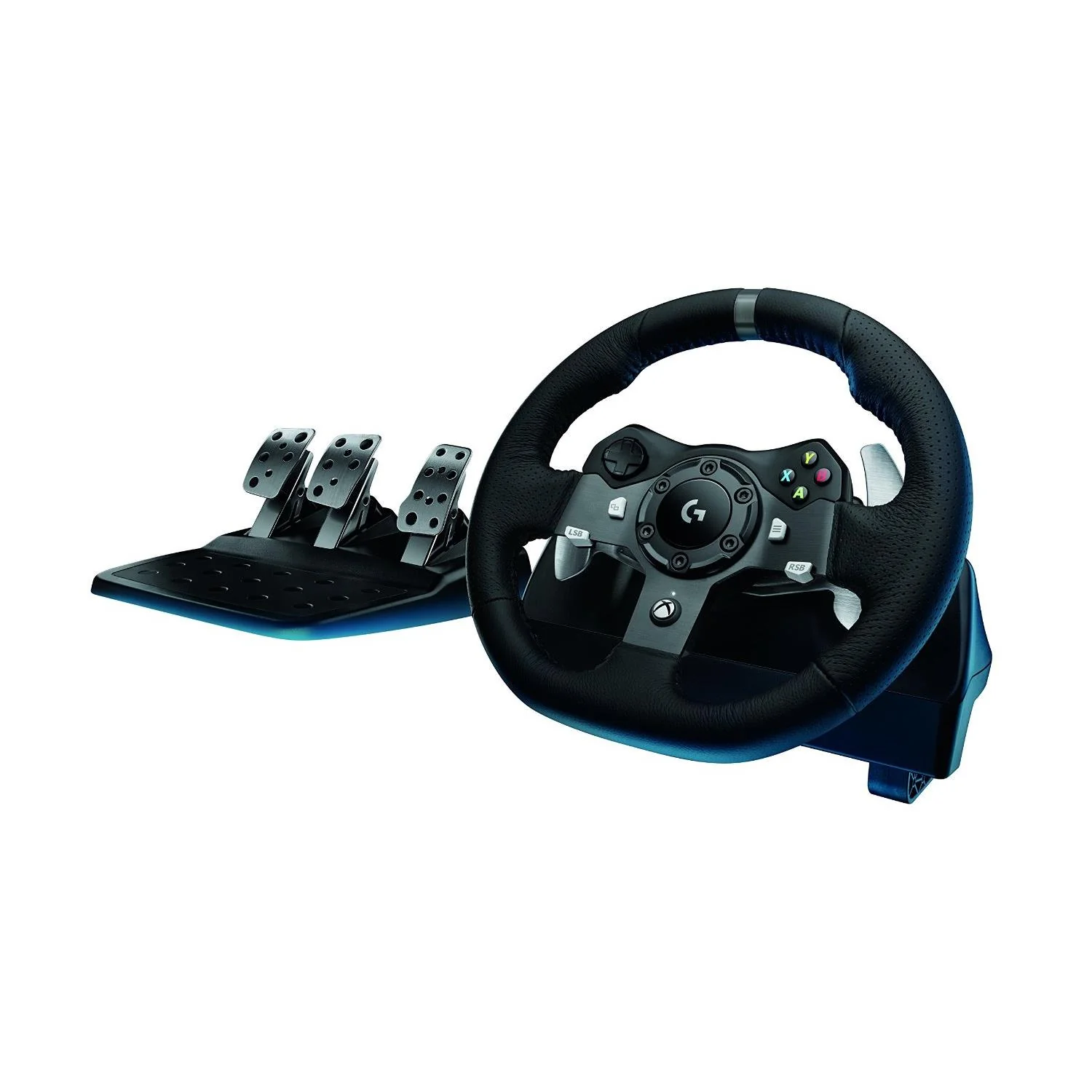
- Wheel rim: Approximately 28 cm (11-inch) diameter, hand-stitched leather wrap for grip and comfort; integrated Xbox button layout and directional pad.
- Paddle shifters: Stainless steel with short throw and a tactile click, positioned for easy reach.
- Pedal set: Included three-pedal array (throttle, brake, clutch) with a progressively resisting brake and sturdy metal pedal faces on a heavy base with a carpet-grip mechanism.
- Mounting: Robust desk clamps plus a hard-mount bolt pattern for cockpits and wheel stands. The wheel stays planted during aggressive driving.
- Connectivity and power: USB connection with an external power supply; integrated cable routing channels help with tidy setup.
- Software: Customization via Logitech G HUB on PC (sensitivity, rotation limits, and profiles). On Xbox, tuning is game-dependent and straightforward.
- Optional shifter: The Logitech Driving Force Shifter (sold separately) adds a 6-speed H-pattern with push-down reverse for manual transmission purists.
Notably, the G920 is the Xbox/PC counterpart to Logitech’s PlayStation-oriented G29. It omits the G29’s rev LEDs and rotary dial but keeps the core mechanics: dual-motor force feedback, leather wrap, metal paddles, and the included three-pedal set.
Performance and Driving Experience
For its price, the G920 delivers convincing, confidence-building force feedback that makes virtual cars feel alive. The dual motors translate steering forces into your hands with enough strength to communicate grip changes and weight transfer. You can sense understeer as the wheel goes light, catch oversteer as it fights back, and feel curbs, rumble strips, and surface changes across tracks and rally stages.
The gear-driven system uses helical gears, which are quieter and smoother than straight-cut gears, reducing the chattering common to older entry-level wheels. That said, gear drive still has a distinct, slightly notchy texture compared to belt-driven or direct-drive systems. You may also notice a small center dead zone in some games, though most racers allow you to adjust deadzone and sensitivity for a tighter feel.
In practice, the force feedback strength is ample for learning car control, executing fast countersteer, and experiencing immersive torque cues in titles like Forza Motorsport, Assetto Corsa, or Dirt Rally. The wheel is energetic and responsive without being fatiguing over long sessions. Road detail is present—especially through curbs and weight shifts—but the sensation is more generalized than the micro-detail you’ll get from belt drives or direct drive bases.
On PC, Logitech G HUB lets you set rotation limits, adjust centering behavior (where applicable), and create per-game profiles. Most fine control, however, comes from in-game settings: force feedback strength, minimum force, damping, and filtering. On Xbox, your tuning lives inside each title. Popular configurations often involve lowering overall FFB slightly for smoother response and dialing in a bit of damping to tame oscillations on straights.
The pedal set is a strong inclusion at this price. The throttle and clutch feel linear and predictable. The brake uses a progressive rubber stop to simulate firmness; it’s intentionally stiff, encouraging pressure-based braking rather than travel-based. New users may find this brake pedal quite tough at first—especially on carpet or without a cockpit—but it rewards a consistent technique and helps build muscle memory. Many buyers add a mat, wheel stand, or cockpit for stability, and the pedal base’s retractable carpet gripper helps keep it in place. Third-party brake mods and load-cell conversions exist for enthusiasts who want an even more realistic, pressure-sensitive brake feel.
Shifting via the metal paddle shifters is crisp and immediate. If you prefer a manual gearbox, the optional Driving Force Shifter adds tactile immersion, particularly for road cars and classic racers. It’s not a heavy-duty shifter like premium add-ons, but it’s solid for the price and fun for casual heel-and-toe practice when paired with the clutch.
In terms of noise, the G920 is quieter than old straight-gear designs but still audible during heavy force feedback events. You’ll hear some gear whine and feel mechanical chatter over aggressive curbs or gravel. Most players find the sound reasonable for shared spaces; late-night sessions next to light sleepers might require gentler FFB settings.
Design and Build Quality
Logitech’s industrial design hits a practical, understated note. The leather-wrapped rim feels premium and stays comfortable during long stints, while the spokes and housing are solid and free of flex. Internal metal components, including the wheel shaft support and paddles, contribute to the G920’s reputation for durability.
The XBOX control set on the wheel face mirrors a gamepad’s essentials: ABXY, D-pad, shoulder inputs, View/Menu, and the Xbox home button. Placement is sensible, and most racers can access critical functions without taking hands off the wheel. Unlike the PlayStation-oriented G29, the G920 lacks rev LEDs and a rotary adjustment dial on the rim, so shift timing cues rely on in-game HUDs or audio.
The paddle shifters are stainless steel with a light, precise action and a satisfying click. They’re wide enough for varied hand positions and reliably register fast upshifts and downshifts. The included pedal set uses metal faces and a heavy base to minimize movement. The base features a carpet grip mechanism that deploys small spikes to lock in on soft surfaces; on hard floors, rubber feet and weight keep it steady.
Mounting is straightforward. Two sturdy clamps secure the wheel to most desks without wobble, and there’s a hard-mount bolt pattern for cockpits and wheel stands. The underside channels guide cables for a tidy setup, and the external power brick keeps heat away from the housing. Overall, the G920 feels like it’s built to take daily use—one of the reasons it’s a frequent recommendation for newcomers and returning sim drivers alike.
Pros and Cons
- Pros
- Great value for an immersive force feedback wheel with a leather rim and metal paddles.
- Three-pedal set included, complete with a clutch and a progressive brake—rare at this price.
- 900-degree rotation and strong game compatibility on Xbox and PC.
- Reliable, durable construction that holds up to heavy use and has excellent resale value.
- Easy to mount to desks or cockpits; neat cable management features.
- Optional H-pattern shifter for added realism without breaking the bank.
- Cons
- Gear-driven FFB can feel notchy compared to belt or direct drive, with some mechanical noise.
- Brake pedal is very stiff out of the box and lacks a true load cell; may require adjustment time or a mod.
- Fewer on-wheel controls than some rivals; no rev LEDs or rotary dial like the G29.
- No TrueForce haptics (found on Logitech’s G923), so subtle audio-driven vibrations are absent in supported games.
- Force feedback detail is good for the price but less nuanced than belt/direct drive systems.
Value Proposition and Pricing
The G920’s enduring popularity comes down to its balance of price, performance, and reliability. At retail, it often sits in the affordable to mid-range bracket for beginner wheels, and it’s frequently discounted—especially during seasonal sales. Considering it includes a three-pedal set with clutch and supports an optional shifter, the out-of-the-box value is compelling.
If you’re shopping new, expect the wheel to undercut many belt-drive competitors while beating most budget wheels on build quality and ecosystem support. If you’re open to the used market, the G920 is common, and parts availability is excellent. Logitech’s long-standing support and driver updates via G HUB help extend its lifespan, and the wheel’s resale value tends to remain strong precisely because it’s a known quantity that just works on Xbox and PC.
Where it shines is as a first serious wheel or a reliable, lower-cost upgrade from no-force-feedback or toy-grade setups. When discounted, the price-to-fun ratio is hard to beat. When priced closer to belt-drive alternatives, the decision becomes less clear-cut; you’ll want to weigh smoother feedback and potential upgrade paths against the G920’s bulletproof reputation and ease of ownership.
Comparison With Alternatives and Who Should Buy It
The racing wheel landscape is more competitive than ever, and understanding where the G920 fits helps clarify if it’s right for you.
Logitech G923 (Xbox/PC): The G923 builds on the G920 with TrueForce, an audio-driven haptics layer that can add texture and vibration in supported games. Its underlying mechanics, rotation, rim, and pedals are broadly similar. If TrueForce-enabled titles are your mainstay and the price gap is small, the G923 is worth a look. If you want maximum value and broad compatibility without paying extra for TrueForce, the G920 remains a smart buy.
Thrustmaster TMX/T150: These are hybrid gear/belt wheels with generally smoother FFB than pure gear systems and competitive pricing. However, the bundled pedals (often two-pedal sets) are more basic unless you buy the “Pro” variants. For Xbox, the TMX is the relevant model. If you prioritize smoother force feedback over pedal quality, TMX Pro can be compelling; if you want a robust three-pedal set included, the G920 is hard to beat.
Thrustmaster T248: A newer hybrid drive wheel with more torque, a small info display on the rim, and presets. It tends to be louder under load than belt-drive systems and costs more than the G920 when the Logitech is on sale. It’s a middle-ground option for users seeking stronger FFB and more on-wheel controls without stepping up to a full belt drive.
Thrustmaster TX/T300RS: Belt-drive bases that offer smoother, more detailed feedback than gear-driven wheels. They’re typically more expensive and often sold as base + rim + pedals separately or in pricier bundles. If you can stretch your budget and value FFB nuance and upgradability, these are meaningful upgrades—though you’ll spend more to get a comparable three-pedal setup.
Fanatec CSL DD / MOZA R3 (and other direct-drive options): These represent a big leap in fidelity and torque, with modular ecosystems and premium pedals available. They are also a big leap in cost, require sturdier mounting, and can be overkill for casual players. If you’re already deep into sim racing or intend to be, saving for direct drive makes sense. For newcomers, the G920 offers an easier, more affordable on-ramp that captures most of the fun at a fraction of the price.
Hori Racing Wheel Overdrive (Xbox): A budget wheel without true force feedback. It’s cheaper but far less immersive. Compared to the Hori, the G920 is in a different league.
Who should buy the Logitech G920?
- First-time sim racers who want real force feedback, a clutch pedal, and reliable build quality on a sensible budget.
- Xbox players who want a proven, plug-and-play wheel that works with a wide library of titles and supports future PC use.
- PC users who value simplicity, broad game support, and an easy setup over complex ecosystems.
- Casual and intermediate drivers who prioritize fun, seat time, and learning racecraft more than chasing ultimate FFB fidelity.
- Families and shared setups where durability and quick mounting/dismounting matter.
Who should look elsewhere?
- Drivers seeking ultra-smooth feedback and the finest detail—consider belt drive (TX/T300) or direct drive (CSL DD, MOZA).
- Enthusiasts who want a load-cell brake out of the box; the G920’s brake is progressive but not pressure-sensing.
- Players who need quiet operation at high FFB forces; gear systems remain audible under stress.
Conclusion
The Logitech G920 Driving Force remains a top recommendation for Xbox and PC sim racers entering the hobby. It pairs durable construction with engaging force feedback, a quality leather rim, and a three-pedal set that accelerates learning and immersion. While gear-drive texture, a stiff brake, and limited on-wheel controls are real compromises, the G920’s value, reliability, and ease of use are hard to beat. If you want maximum fun per dollar and broad compatibility, it’s still a standout choice.