
HyperX Pulsefire Haste Gaming Mouse Review: Ultra‑Light Precision on a Budget
Introduction
The HyperX Pulsefire Haste has become a go-to recommendation for gamers who want an ultra-light mouse without paying premium prices. Designed for speed and accuracy, it features a perforated shell, a flexible "HyperFlex" cable, and a proven PixArt sensor that targets competitive play. In this review, we dive into its specs, real-world performance, design choices, value for money, and how it stacks up against key rivals to help you decide if it belongs on your desk.. For a Prefer an affordable lightweight that cuts the cord? The NZXT Lift Wireless delivers similar low weight with solid battery life and value., consider our NZXT Lift Wireless.
Key Features and Specifications
The Pulsefire Haste aims to deliver esports-ready performance in a streamlined, wallet-friendly package. Here are the standout features and what they mean for day-to-day use:
- Ultra-lightweight design: Approximately 59 g (without cable). This low mass reduces inertia for faster flicks and less fatigue during extended sessions.
- High-performance sensor: PixArt PAW3335 optical sensor with up to 16,000 DPI, 450 IPS tracking speed, and up to 40G acceleration, enabling precise tracking across a wide range of sensitivities.
- Polling rate: Up to 1000 Hz (1 ms) for responsive input in fast-paced titles.
- Switches: TTC Golden Micro dustproof switches rated for up to 60 million clicks, tuned for crisp tactility and longevity.
- Buttons: Six total (left, right, clickable scroll wheel, DPI toggle, and two side buttons). The layout is simple and intuitive for most games.
- Cable: HyperX HyperFlex USB paracord-style cable designed to minimize drag and resistance.
- Feet (skates): Virgin-grade PTFE skates for smooth, consistent glide on cloth and hard pads; replacement feet are often included in the box.
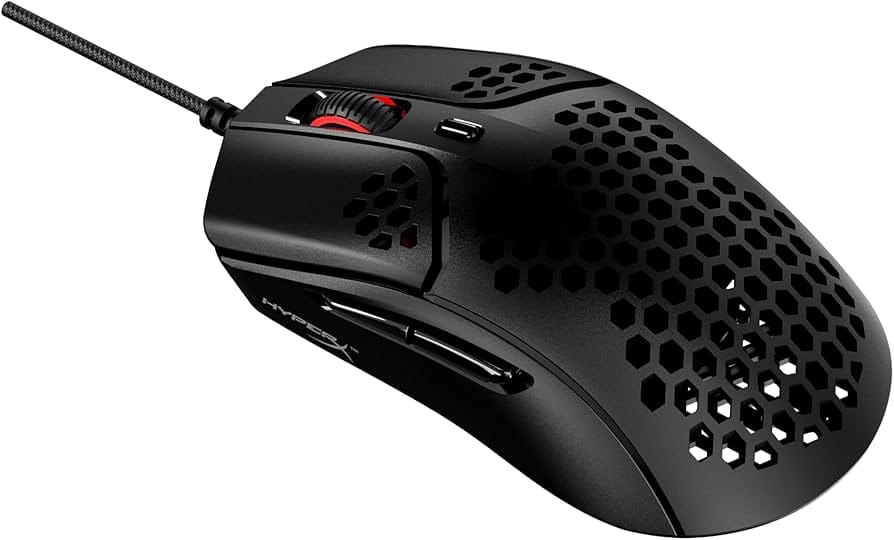
- Shell and coating: Honeycomb top and bottom shells with a matte finish to enhance grip while keeping weight low.
- Water- and dust-resistance considerations: The internal PCB uses a protective coating and the TTC switches are dustproof to help mitigate the typical drawbacks of perforated designs.
- RGB lighting: A single-zone RGB on the scroll wheel, subtle enough for minimalist setups.
- Software: HyperX NGENUITY for DPI steps, polling rate, button remaps, macro assignments, and lighting control.
- Shape and handedness: Symmetrical shell with side buttons on the left, making it best suited for right-handed users; optimized for claw and fingertip grips, but viable for smaller-hand palm grips.
Altogether, the specification sheet positions the Pulsefire Haste as a serious contender for FPS and competitive gaming, particularly for players who prefer low-to-mid sensitivity aiming styles and need effortless micro-adjustments.
Performance and Quality
Performance is where the Pulsefire Haste justifies its enduring popularity. The PixArt PAW3335 sensor is a known quantity—efficient, accurate, and dependable across a wide DPI range. In practice, it exhibits stable tracking without noticeable jitter or angle snapping when those features are disabled in software. Flick shots in tactical shooters feel controlled, while micro-corrections for tracking in arena shooters remain predictable and repeatable.
The 1000 Hz polling rate keeps input latency competitive. While some flagship mice tout higher rates, the tangible improvement beyond 1000 Hz is often subtle and system-dependent. For most players, the Pulsefire Haste’s responsiveness feels immediate, with click-to-shot delays staying imperceptible in real-world testing.
Glide quality is another strong point. The virgin-grade PTFE skates are generously sized, resulting in a buttery, low-friction feel on cloth pads and a slippery, fast glide on hard surfaces. If you’re coming from heavier or rubber-footed mice, expect a short adjustment period as your muscle memory adapts to the lighter weight and reduced resistance.
Click feel on the TTC Golden Micro switches is crisp and consistent. The main buttons have minimal pre-travel and a satisfying tactile bump. Side buttons are well-placed and easy to distinguish by feel, offering a light-to-medium actuation force that avoids accidental presses while remaining quick to trigger for melee or utility binds. The scroll wheel has defined steps with a grippy rubberized ring, and the middle-click is firm without being fatiguing.
Lift-off distance (LOD) is appropriately low and can be tuned via NGENUITY on many surfaces. For low-sense players who frequently reposition the mouse, the consistent LOD helps prevent unwanted cursor movement when lifting and setting down, which is crucial during hectic engagements.
Durability-wise, the honeycomb cutouts don’t compromise the structural feel during typical use. There’s minimal shell flex and no prominent creak under normal grip pressure. The dustproof switch design and PCB coating are practical touches for a perforated mouse, reducing the chance of debris-related issues over time.
Design and Build Quality
HyperX strikes a balance between minimalist aesthetics and functional engineering. The Pulsefire Haste’s symmetrical shape is safe and familiar, with gentle curves that work well across grip styles. The highest point of the hump sits slightly toward the rear, supporting claw and fingertip grips especially well. Users with small-to-medium hands may find it comfortable for a relaxed palm grip; very large hands may prefer a taller or longer shell for full palm support.
The matte coating promotes a confident hold without becoming overly slick during intense sessions. Combined with the low mass, the mouse encourages quick, precise movements and reduces strain over multi-hour play. Many retail packages also include pre-cut grip tape for the main buttons and side panels. If you prefer a more textured feel—or play in warmer environments—the included grips can be transformative without adding much weight.
The honeycomb shell reduces weight while maintaining rigidity. Perforations cover the top and bottom, improving airflow for sweaty hands, though some users may feel the edges depending on grip. HyperX’s fit and finish is tidy: cutouts are clean, seams are subdued, and the shell exhibits little rattle. The scroll wheel is centered and stable, with a tight axle that avoids wobble common in budget ultralights.
The HyperFlex cable is a highlight. It’s light, supple, and resists kinking, significantly cutting down on cable drag. Pair it with a bungee and the wired Haste comes surprisingly close to a wireless feel. This matters in high-stakes FPS where even small sources of friction can throw off trajectories or micro-adjustments.
Underneath, the PTFE feet are slightly rounded at the edges to minimize catching on soft pads. Replacement skates in the box extend the mouse’s lifespan and let you refresh the glide without shopping for third-party feet. Maintenance is straightforward: compressed air or a soft brush can clear dust from the shell openings; the coated PCB and dustproof switches add a layer of assurance against typical debris ingress.
Pros and Cons
Even well-balanced peripherals have trade-offs. Here’s a clear-eyed look at where the Pulsefire Haste shines and where it might fall short for certain users:
- Pros
- Excellent weight-to-price ratio at roughly 59 g without sacrificing structural integrity.
- Reliable PixArt PAW3335 sensor with strong tracking and low-latency input at 1000 Hz.
- Superb glide from virgin PTFE skates; replacement feet typically included.
- Comfortable, safe shape suitable for claw and fingertip grips; works for smaller-hand palm users.
- Flexible HyperFlex cable delivers near-wireless freedom when used with a bungee.
- Dustproof TTC Golden Micro switches rated for longevity and consistent click feel.
- Simple, tasteful RGB limited to the scroll wheel; easy to integrate into any setup.
- Thoughtful extras: optional grip tapes and spare skates extend customization and lifespan.
- Software allows DPI, polling, lighting, and button remaps without being overly complex.
- Cons
- Perforated shell isn’t for everyone; some users dislike the feel of honeycomb cutouts.
- Right-handed only in practice due to left-side buttons, despite the symmetrical shell.
- Single RGB zone and understated styling may be too plain for RGB-heavy builds.
- Medium-sized shape may not fully satisfy very large-hand palm grippers who want a taller hump.
- NGENUITY software is functional but can feel basic compared to some competitors’ suites.
Value, Pricing, and Competitor Comparison
One of the Pulsefire Haste’s biggest draws is its value. Its MSRP commonly sits in the budget-to-midrange category, and it’s frequently discounted at major retailers. Considering the build quality, sensor performance, and included extras (spare skates and grip tape), it outperforms many mice at similar or even higher price points. If you’re assembling a cost-conscious competitive gaming setup, the Haste is an easy recommendation.. If you're considering alternatives, our Razer Viper Ultimate review covers a If you love the Haste’s ultralight feel but want true wireless with top‑tier latency, consider the Razer Viper Ultimate as a premium alternative..
How does it compare to other popular ultralights and esports mice?
- Glorious Model O / O- (wired): The Model O series offers a similar honeycomb ethos and competitive weight. It typically costs in a comparable range and has a slightly different shape—flatter and longer—suited to claw and fingertip users who like a broader shell. The Haste’s TTC switches and PTFE feet hold their own; choosing between them often comes down to shape preference and aesthetic taste.
- Razer Viper Mini: Lighter than many budget mice and often very affordable, the Viper Mini boasts a low-latency experience with a smaller, lower-profile shell. If you have small hands or prefer a compact mouse, the Viper Mini is compelling. The Pulsefire Haste, however, offers a more accommodating medium size, a different click feel, and includes spare skates and grip tape that add practical value.
- Logitech G Pro X Superlight (wireless): This is a premium, much pricier option that sets a benchmark for lightweight wireless performance. If you demand top-tier wireless freedom and are willing to pay a significant premium, the Superlight is exceptional. For most players seeking strong performance per dollar, the Haste remains the more rational buy—especially if you don’t mind a cable.
- SteelSeries Aerox 3 (wired): Another honeycomb contender with IP54-like environmental protection on some variants. It’s competitive on weight and aesthetics with a slightly different shape. The Haste counters with its simple, proven feel, gentle curves, and the excellent HyperFlex cable.
- HyperX Pulsefire Haste Wireless: If you love the Haste’s shape and features but want to ditch the cable, the wireless model adds 2.4 GHz connectivity and multi-day battery life at a higher price. It’s a strong upgrade path, though the wired Haste remains the better value if you’re budget-focused.
From a pure price-to-performance standpoint, the Pulsefire Haste consistently sits near the top of the pack. Its component choices—particularly the sensor, skates, and cable—deliver the kind of usability typically reserved for costlier mice. When discounted, it becomes one of the best deals for competitive FPS players entering the ultralight category.
Who Should Buy the HyperX Pulsefire Haste
The Pulsefire Haste caters to a broad audience but has a particularly strong appeal in a few scenarios:
- Competitive FPS gamers: If your playstyle involves rapid flicks, frequent micro-corrections, and extended sessions, the low weight, smooth skates, and reliable sensor deliver exactly what you need.
- Claw and fingertip grip users: The medium size and hump placement favor grips that emphasize control and agility. Smaller-hand palm grippers may also find it comfortable.
- Budget-conscious enthusiasts: You get a high-end feeling glide and click response for a fraction of flagship prices, especially during sales.
- Players who value simplicity: Minimal RGB, a sane button layout, and unobtrusive software make it easy to set and forget.
On the other hand, if you dislike perforated shells, need a true left-handed layout, or require a taller, fuller palm shape for very large hands, you might prefer alternatives with closed shells or more pronounced humps. And if going wireless is non-negotiable, consider the Pulsefire Haste Wireless or other low-latency wireless options.
Conclusion
The HyperX Pulsefire Haste delivers the essentials that matter to competitive players: featherweight handling, dependable sensor performance, slick skates, and a flexible cable—all at a price that feels refreshingly grounded. It’s comfortable, consistent, and thoughtfully accessorized with spare feet and optional grips. While the honeycomb shell and understated styling won’t suit every preference, the performance-per-dollar calculus is undeniable. If you’re seeking an ultralight wired mouse that punches well above its price, the Pulsefire Haste deserves a top spot on your shortlist.