
Corsair HS80 RGB Wireless Review: Atmos-Ready Sound, Low-Latency Wireless, and All‑Day Comfort for Competitive Play
Introduction
The Corsair HS80 RGB Wireless is a 2.4 GHz gaming headset designed for PC and PlayStation gamers who want low-latency audio, clear team comms, and modern styling without a desk full of cables. With Dolby Atmos for Headphones on Windows, a comfortable floating headband, and Corsair’s Slipstream Wireless, it aims to deliver immersive game audio and dependable performance. This review covers real-world sound, build quality, battery life, software, and how it stacks up against popular alternatives.. For a Positioned as a more premium alternative if you want higher-end materials and a more upscale design within Corsair’s wireless lineup., consider our Corsair Virtuoso RGB Wireless.
Key features and specifications
The HS80 RGB Wireless targets the sweet spot where comfort, reliable wireless, and spatial audio meet. Rather than cramming in every possible input, Corsair focuses on a fast 2.4 GHz link, strong PC integration, and day-to-day ease of use. Here are the highlights buyers care about most:. For a Mention as a lightweight competitor if you prioritize long-session comfort and a playful aesthetic over a more subdued look., consider our Logitech G733 Lightspeed Wireless.
- Wireless platform: Corsair Slipstream 2.4 GHz via USB-A dongle for low-latency, high-stability PC and PlayStation connections.
- Drivers: Custom 50 mm neodymium dynamic drivers tuned for detail and positional accuracy.
- Spatial audio: Dolby Atmos for Headphones license on Windows (via the Dolby Access app). PS5 works with Sony’s Tempest 3D Audio in supported titles.
- Microphone: Flip-to-mute, “broadcast-grade” omnidirectional boom mic with a status LED and Discord certification.
- Battery and charging: Up to around 20 hours per charge (usage and lighting dependent), USB-C charging, and the ability to play while charging.
- Wired high-res mode: Up to 24-bit/96 kHz audio when used over USB on PC. Wireless operates at a lower sampling rate for battery and latency efficiency.
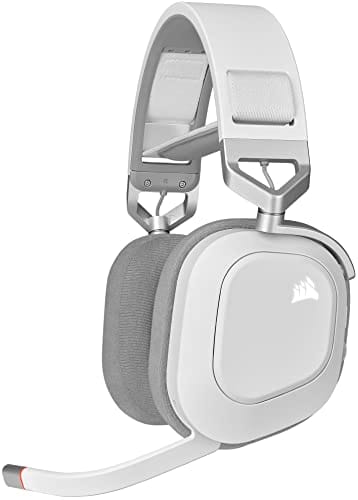
- Build and comfort: Memory foam, breathable fabric ear pads; suspended (floating) headband for even weight distribution; metal-reinforced yokes.
- Controls: On-ear volume wheel, power button, and automatic mic mute when flipped up.
- Lighting: Subtle RGB Corsair sails logos, configurable in iCUE on PC.
- Software: Corsair iCUE for EQ presets, custom EQ, mic sidetone and gain, lighting, and profile management.
- Compatibility: PC (Windows), PlayStation 4/5, and macOS (stereo, with limited software features). Not designed for Xbox systems. No Bluetooth, no 3.5 mm analog.
While Corsair does not chase feature overload, the essentials are well covered. The headset’s focus is low-latency wireless and spatial audio on PC, with straightforward PS5 support. The lack of Bluetooth or analog input is deliberate and keeps latency consistent, but it also narrows use cases for commuters or mobile gamers.
Build materials are a strong point. The suspended headband reduces pressure hotspots during long sessions, and the fabric pads breathe more than leatherette alternatives. The RGB implementation is intentionally restrained: a small logo glow that can be switched off to stretch battery life.
For audio enthusiasts, the ability to switch to wired USB and unlock higher-resolution playback is useful for music breaks between matches. Keep in mind that surround virtualization (Dolby Atmos) is a PC software feature; on PlayStation you get Sony’s Tempest 3D Audio where games support it, but not Dolby Atmos processing.
Performance and sound quality
The first thing you notice about the HS80 RGB Wireless is how clean and positional the sound is for a 2.4 GHz headset at this price. The 50 mm drivers aim for an articulate, mildly V-shaped signature that favors clarity without burying subtle game cues under booming bass. Footstep articulation and midrange detail come through, while low-end punch still lands with enough weight to make explosions satisfying.
Positional accuracy and imaging are the stars here. In competitive shooters, left-right panning and front-back depth are solid, and with Dolby Atmos enabled on PC, vertical cues and distance perception improve further. You can track reloads behind you or a zipline above you more easily than with many budget headsets. The stage is not cavernous, but it is well organized, which helps your brain place sounds rapidly during firefights.
Frequency balance is tuned for games first. Bass has controlled slam rather than sub-bass rumble, which keeps the midrange from getting masked. Vocals, callouts, and environmental effects (like doors and glass) stay prominent. Treble is crisp and airy; at very high volumes some users sensitive to brightness may prefer a slight EQ dip around the upper treble to tame splash on sibilant tracks or grenade pings. Corsair’s iCUE presets are a decent starting point, and a quick custom EQ can yield a more relaxed long-session tonality if you want it.
For music listening, the HS80 is competent and enjoyable—especially in wired USB mode where the resolution ceiling is higher—but its tuning is still gaming-forward. Rock, pop, and EDM benefit from the snappy bass and clear mids. Classical and jazz can sound slightly compact compared with open-back audiophile headphones, which is expected in a closed gaming headset. Detail retrieval remains good for the class, and the headset never sounds muddy.
Wireless stability and latency with Slipstream are excellent. In typical home environments the link remains steady through a room or two, and audio/video sync is tight enough for competitive play and streaming video without noticeable lag. Expect the best results with the dongle on a front-panel or short extension to reduce USB port interference near dense cabling.
Microphone quality ranks above average for a wireless gaming headset. The boom mic captures clear speech with natural mids and a touch of brightness for intelligibility. The flip-to-mute action is precise and the LED status light is helpful. Noise rejection is good for keystrokes at moderate distances, though this is not a broadcast XLR mic; in louder rooms you may still transmit some background fan or mechanical keyboard chatter. In iCUE, sidetone and gain controls make it easy to dial a level that avoids peaking.
Battery life is rated up to around 20 hours, with real-world results depending on volume, mic usage, and whether RGB is enabled. With lighting off and moderate volume, full-day sessions are realistic. Some rivals now exceed 50 or even 200+ hours, so the HS80’s endurance is competitive but not class-leading. The saving grace is USB-C quick top-ups and the ability to continue playing while charging via USB.
Finally, software and spatial audio. Dolby Atmos for Headphones on Windows elevates location cues in supported titles and can also enhance movies with height effects. It doesn’t create literal surround speakers, but the virtualization is among the most convincing available. iCUE’s EQ and mic controls are straightforward; if you prefer a set-and-forget approach, choose an EQ preset, disable RGB to extend battery life, and you’re done.
Design and build quality
A headset’s comfort often matters more than its spec sheet, and the HS80 scores well in daily wearability. The suspended headband spreads weight across a fabric strap rather than concentrating it on a single padded bar, which reduces hot spots during multi-hour sessions. Clamping force is firm enough to keep the cups stable during movement but not vise-like, and the breathable fabric pads wick heat better than leatherette in warm rooms.
The ear cups have a modern, angular silhouette with a soft-touch finish. They tilt and swivel enough to fit a variety of head shapes, and the memory foam pads recover quickly. Sound isolation is moderate; you’ll block a good amount of household noise, but this is not a noise-canceling headset and it doesn’t fully mute mechanical keyboards nearby.
Materials and durability feel solid for the price. Metal-reinforced yokes add confidence when adjusting the cups daily, and the hinges don’t creak. The fabric headband strap is replaceable if it wears over time, and the USB-C charging port is snug without wobble. At approximately the high-300-gram range, the HS80 isn’t the lightest wireless headset on the market, but most users will find it comfortable thanks to the suspended design.
Controls and ergonomics are intentionally simple: a tactile volume wheel and a power button live on the left ear, and the microphone mutes automatically when you flip it up. There’s no complex touch interface to learn. The RGB logos are small and tastefully done, and they can be disabled for more understated looks or longer battery life.
On the software side, Corsair’s iCUE is capable yet approachable. You can build multiple EQ presets for different genres, set mic sidetone so you hear just enough of your voice, and link lighting effects to other Corsair gear. Profiles can auto-switch with apps, so your “Shooter” preset can load when you launch your favorite FPS while a warmer “Cinema” profile handles movie nights.
There are a few design trade-offs to note. There’s no Bluetooth or 3.5 mm analog input, which means this is not a travel headset and it won’t plug into controllers or phones without USB. Xbox consoles aren’t supported on the standard HS80 RGB Wireless model. If broad connectivity is your top priority, you should consider it before buying; Corsair optimized this model for PC and PlayStation first.
Pros and cons
- Pros
- Low-latency, stable 2.4 GHz Slipstream wireless connection for competitive play.
- Convincing spatial audio with Dolby Atmos on PC; supports PS5 Tempest 3D Audio in compatible titles.
- Balanced, detailed sound signature that preserves footsteps and environmental cues.
- Comfortable suspended headband and breathable fabric pads for long sessions.
- Good microphone clarity for a wireless headset; flip-to-mute with status LED.
- USB-C charging, usable while charging; high-resolution audio in wired USB mode on PC.
- Clean design with subtle, optional RGB; sturdy metal-reinforced yokes.
- iCUE software offers useful EQ, mic, and lighting controls without bloat.
- Cons
- No Bluetooth or 3.5 mm analog; limited to USB wireless and USB wired.
- Not designed for Xbox consoles; compatibility is PC, macOS (limited), and PlayStation.
- Battery life is good but not class-leading versus some newer rivals with 50–300+ hour claims.
- Treble can read a touch bright at high volumes; may benefit from a mild EQ tweak for music.
- Isolation is moderate; very loud keyboards or fans may still be audible.
- Heavier than some ultralight competitors, though the suspended design offsets the weight well.
Value, pricing, and comparison with alternatives
The Corsair HS80 RGB Wireless launched around the mid-range price point for wireless gaming headsets. Its MSRP commonly sits in the ~$149.99 bracket, and it often sells for less during seasonal promotions. At or under $130, it’s a compelling value given its build quality, spatial audio on PC, and daily-wear comfort. Even at full price, the package is competitive if you prioritize low-latency wireless and strong positional audio.
Here’s how it stacks up to a few common alternatives you might be cross-shopping:
- HyperX Cloud Alpha Wireless: Famous for an absurd battery life (often quoted at 300 hours) and a warm, fun tuning. It lacks Atmos out of the box and is more conservative on software features. If battery life is your top priority, HyperX leads; for spatial processing and PC ecosystem integration, Corsair has the edge.
- SteelSeries Arctis Nova 7: A versatile multi-platform option with simultaneous 2.4 GHz and Bluetooth, great for mixing phone calls with game audio. Battery life and comfort are strong, and the tuning is balanced. If you need Bluetooth and console flexibility, Nova 7 is hard to beat; if you don’t, the HS80 can save money while delivering excellent PC spatial performance.
- Razer BlackShark V2 Pro (2023): Lightweight with excellent mic and long battery life, tuned for esports clarity. Razer Synapse is powerful but heavier on system resources. The Corsair HS80 feels more premium in materials and offers Atmos on PC; Razer counters with longer endurance and lighter weight.
- Logitech G Pro X 2 Lightspeed: Premium price with very low weight and refined drivers. It’s excellent but significantly more expensive. The HS80 represents better value-per-dollar if you’re budget-sensitive.
From a value perspective, the HS80’s main give-up versus some rivals is battery life and universal connectivity. However, its cost-to-performance ratio is excellent if you live in the PC and PlayStation ecosystem. The combination of Dolby Atmos support on Windows, consistent wireless latency, and a robust mic makes it easy to recommend in the segment.
Pricing does fluctuate, so if you find the HS80 around $100–$130, it becomes a standout mid-range buy. If it’s closer to full MSRP and you want Bluetooth or ultralong battery life, consider the alternatives above and weigh which feature you’ll actually use most.
Who should buy this product
The HS80 RGB Wireless isn’t trying to be everything to everyone, and that’s a good thing. It’s targeted, polished, and well-suited to several types of gamers:
- PC players who want spatial audio for competitive advantage: If you play shooters or battle royale titles and value positional cues, Atmos on Windows is a meaningful upgrade, and the core tuning preserves footsteps and midrange detail.
- PS5 owners who want dependable wireless without fuss: Plug in the dongle, enable 3D Audio in system settings for supported games, and you’re set. The controls are simple and the mic is reliable for party chat.
- Gamers who marathon sessions: The suspended headband and fabric pads reduce hot spots and heat buildup. If you’re sensitive to clamp, the strap design helps distribute pressure evenly.
- Streamers and squad leaders who need clear comms: The boom mic is crisp for callouts, with an easy flip-to-mute gesture and sidetone control to avoid shouting.
- Players with a Corsair ecosystem: If you already use a Corsair keyboard, mouse, or AIO cooler, iCUE makes it simple to sync profiles and lighting and keep everything in one app.
It may be less ideal if you need Bluetooth for phones, a 3.5 mm jack for controllers, or Xbox compatibility on the standard model. In those cases, look to a mixed-connectivity headset like the SteelSeries Nova 7 or a dedicated Xbox variant.
Conclusion
The Corsair HS80 RGB Wireless nails the fundamentals that matter: convincing positional audio on PC with Dolby Atmos, low-latency Slipstream wireless, a comfortable suspended headband, and a clear flip-to-mute microphone. Battery life is good but not record-breaking, and the lack of Bluetooth or analog limits versatility. If your gaming world revolves around PC and PlayStation and you want an affordable, polished wireless headset with strong spatial cues, the HS80 is an easy, confidence-inspiring recommendation.